

STEM careers—those related to science, technology, engineering and mathematics—are some of the most in-demand and highest-paying jobs in the country. These roles power industries such as health care, information technology, manufacturing processes and environmental science, making them central to today’s job market and the adoption of new technologies.
To better understand where STEM careers offer the strongest earning potential, an analysis of national employment and wage data was conducted on behalf of Florida Institute of Technology. The following findings are based on U.S. Bureau of Labor Statistics (BLS) data. This report focuses on STEM occupations across all 50 states, highlighting top-paying roles, earnings by location and wage growth patterns, all factors that matter to students and professionals planning their career paths.
Key Takeaways
- Based on median annual salary, architectural and engineering managers are the highest-paid STEM professionals in the U.S., earning $157,500 per year.
- STEM professionals in California earn over $25,000 more than the national average.
- In Minnesota, the top-paying STEM job, physicist, earns $222,550 annually, making it the highest-paid STEM job among all states.
- Surveyors, actuaries and microbiologists are seeing the fastest year-over-year wage growth, each up around 12%.
The Highest- and Lowest-Paying STEM Jobs Nationwide
STEM occupations span entry-level roles and advanced positions that typically require a bachelor’s degree, a master’s degree or a graduate degree in a related field. Salary outcomes often reflect education level, leadership responsibilities and the complexity of scientific research or computer systems involved.
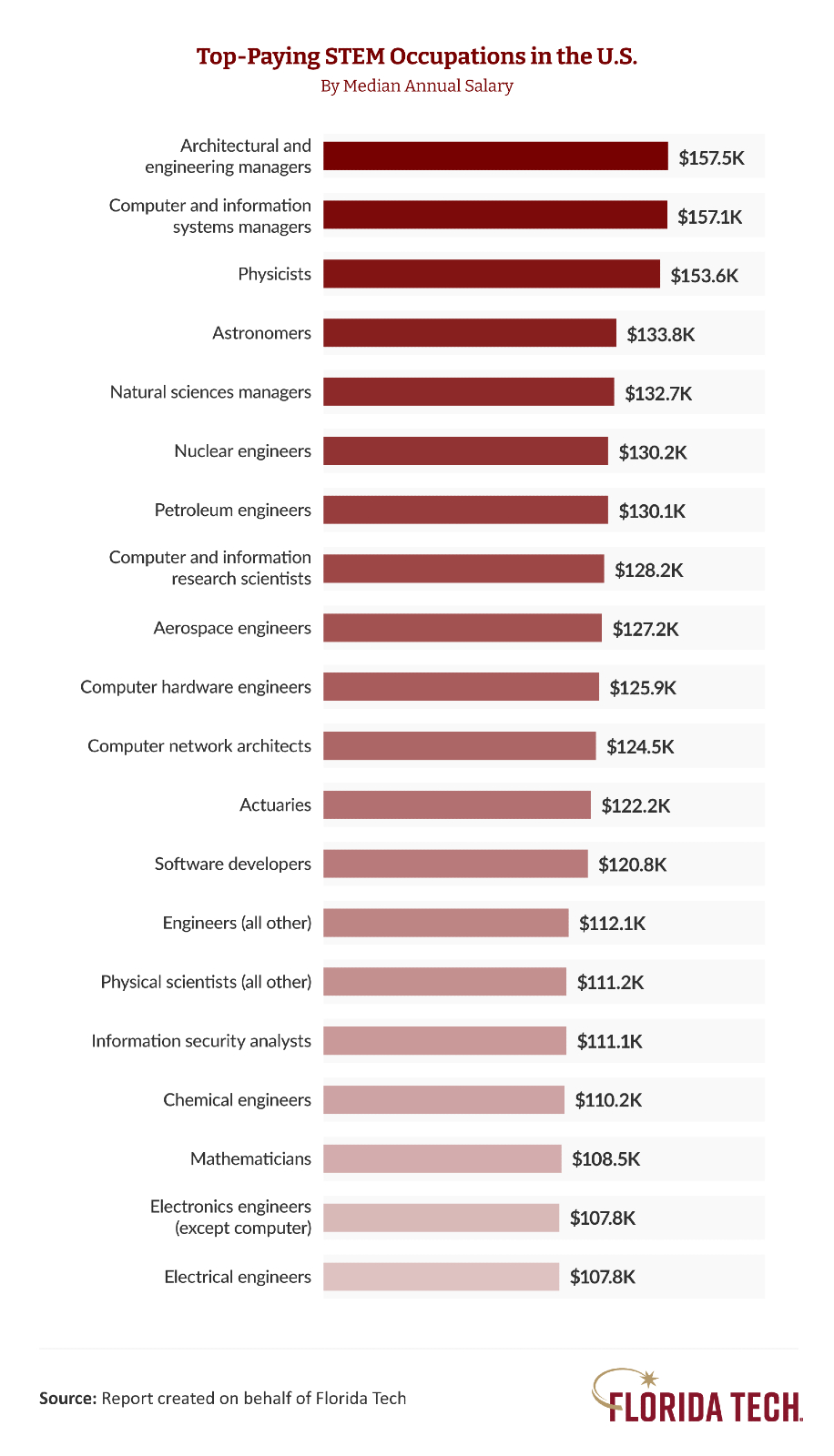
At the top end, management and highly specialized roles dominate the highest-paying STEM fields. Architectural and engineering managers earn a median salary of $157,500, followed closely by computer and information systems managers at $157,100 and physicists at $153,600. These roles often oversee large teams, advanced projects or cutting-edge research tied to artificial intelligence, cybersecurity, aerospace engineering and biomedical engineering.
Engineering, computer science and mathematics-based roles show strong earning potential across the board. The following occupations all exceed the $100,000 median salary mark, underscoring the financial return of many STEM majors:
- Petroleum engineers
- Chemical engineers
- Aerospace engineers
- Actuaries
- Software developers
- Information security analysts and mathematicians
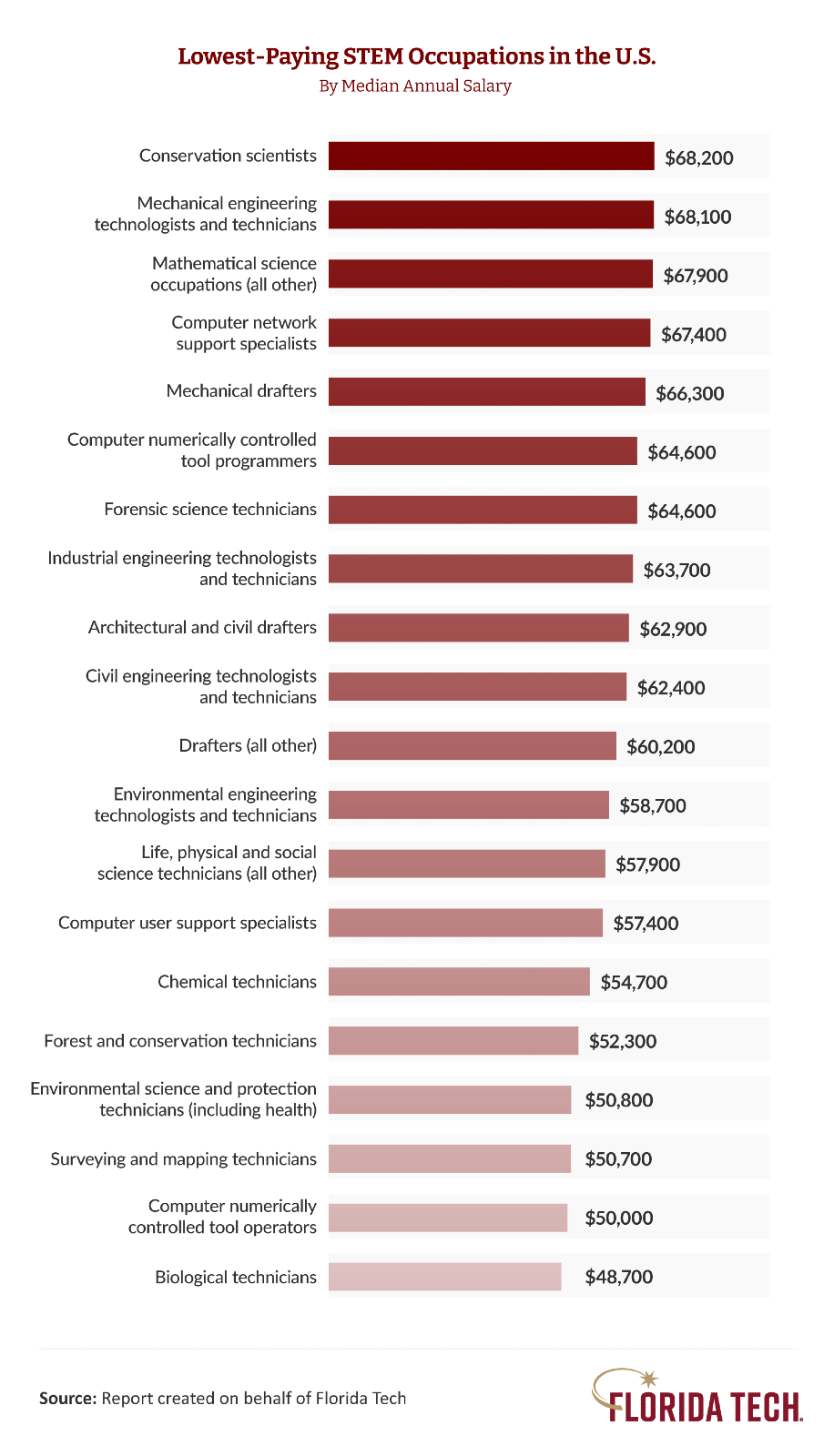
Not all STEM jobs command high salaries, but they often serve as entry-level pathways into STEM careers. These roles can provide experience that leads to advancement through certifications or additional education. The lowest-paying STEM occupations by median annual salary are:
- Conservation scientists: $68,200
- Mechanical engineering technologists and technicians: $68,100
- Mathematical science occupations (all other): $67,
- Computer network support specialists: $67,400
- Mechanical drafters: $66,300
- Forensic science technicians: $64,600
- Computer numerically controlled tool programmers: $64,600
- Industrial engineering technologists and technicians: $63,700
- Architectural and civil drafters: $62,900
- Civil engineering technologists and technicians: $62,400
- Drafters (all other): $60,200
- Environmental engineering technologists and technicians: $58,700
- Life, physical and social science technicians (all other): $57,900
- Computer user support specialists: $57,400
- Chemical technicians: $54,700
- Forest and conservation technicians: $52,300
- Environmental science and protection technicians (including health): $50,800
- Surveying and mapping technicians: $50,700
- Computer numerically controlled tool operators: $50,000
- Biological technicians: $48,700
How STEM Salaries Vary by Statel
Geography plays a major role in STEM professionals’ earning potential. Differences in industry concentration, cost of living and sector investments all influence average salaries.
STEM professionals in California earn the most on average, at $115,368, which is more than $25,000 above the national average for all the occupations in this study ($90,000). Several other coastal and innovation-driven states followed closely, benefiting from dense job markets tied to industries such as computer science, information technology and advanced manufacturing. The top 10 STEM-earning states by average median salary are:
- California: $115,368
- Washington: $105,374
- Massachusetts: $104,832
- Maryland: $102,906
- New Jersey: $100,512
- New York: $99,211
- Virginia: $98,323
- Colorado: $98,218
- Alaska: $96,528
- Connecticut: $96,519
Lower average salaries are more common in states with fewer STEM employers or less concentration in high-paying fields. The bottom 10 STEM-earning states by average median salary are:
- South Dakota: $75,851
- Mississippi: $76,229
- Arkansas: $76,546
- Kentucky: $80,952
- Nebraska: $81,722
- Montana: $81,754
- Indiana: $81,815
- Vermont: $82,589
- Iowa: $83,414
- West Virginia: $83,564
The Top-paying STEM Job in Each State
Looking beyond averages reveals which specific STEM occupations drive top salaries at the state level. Leadership roles and advanced scientific positions frequently ranked highest in this analysis.
Minnesota, where physicists earn $222,550 annually, stood out nationally as the state with the highest top-paying STEM salary. The top 10 states for the highest-paying STEM occupations are:
- Minnesota – Physicists: $222,550
- Washington – Computer and information research scientists: $221,990
- Massachusetts – Natural sciences managers: $218,800
- New Mexico – Architectural and engineering managers: $215,730
- California – Computer and information systems managers: $211,340
- New York – Computer and information systems managers: $209,980
- Florida – Physicists: $209,020
- Pennsylvania – Physicists: $208,470
- New Jersey – Natural sciences managers: $202,310
- Alaska – Petroleum engineers: $200,750
In lower-paying states, the top STEM jobs exceed $135,000, which shows that high earning potential exists nationwide, even where average salaries lag. The bottom 10 states for highest-paying STEM occupations:
- Mississippi – Architectural and engineering managers: $136,010
- Maine – Architectural and engineering managers: $140,430
- North Dakota – Architectural and engineering managers: $140,560
- Montana – Computer hardware engineers: $141,680
- Arkansas – Biochemists and biophysicists: $143,490
- Indiana – Architectural and engineering managers: $144,880
- Nebraska – Nuclear engineers: $149,280
- Iowa – Aerospace engineers: $150,010
- Wyoming – Petroleum engineers: $152,770
- Nevada – Architectural and engineering managers: $153,340
Fastest-growing STEM Occupations by Salary
Salary is only one measure of opportunity, but year-over-year pay growth can signal rising demand for certain skills. These trends help highlight which STEM roles are seeing increasing earning potential, particularly for graduates entering the workforce or professionals considering a career shift.
From 2023 to 2024, surveyors, actuaries and microbiologists saw the fastest median salary growth, with pay increasing by 12% or more in each role. Many of these occupations support expanding needs in data analysis, public health, environmental monitoring and operations research, areas where specialized expertise continues to command higher wages.
Top 10 STEM occupations by median salary growth:
- Surveyors: +12.5%
- Actuaries: +12.3%
- Microbiologists: +12.0%
- Physicists: +11.6%
- Engineering technologists and technicians (except drafters, all other): +11.5%
- Architects (except landscape and naval): +11.4%
- Cartographers and photogrammetrists: +10.9%
- Electromechanical and mechatronics technologists and technicians: +10.2%
- Animal scientists: +10.2%
- Civil engineers: +9.5%
Some STEM teaching and research roles saw modest declines in median pay. These changes may reflect shifts in funding, enrollment or institutional budgets rather than a broader weakening of STEM fields overall.
Bottom 10 STEM occupations by median salary growth:
- Medical scientists (except epidemiologists): -6.1%
- Agricultural engineers: -4.6%
- Conservation scientists: -3.2%
- Physics teachers (postsecondary): -1.8%
- Engineering teachers (postsecondary): -1.4%
- Forestry and conservation science teachers (postsecondary): -1.3%
- Mathematical science teachers (postsecondary): -0.8%
- Chemistry teachers (postsecondary): -0.8%
- Computer systems analysts: -0.7%
- Architecture teachers (postsecondary): -0.6%
What These Findings Mean for Your STEM Career
The data shows that STEM careers continue to offer strong earning potential, but outcomes depend heavily on role, specialization and location. Management positions, advanced engineering roles and research-focused careers consistently paid the most, while technician and support roles tended to earn less but can still serve as entry points into high-demand STEM fields.
For students and working professionals, this information can help guide decisions about education and career planning. Choosing a STEM major with strong demand, pursuing certifications or a graduate degree, or relocating to a state with higher average salaries can significantly impact long-term earning potential. Understanding where opportunities are growing also helps align skills with future job market needs.
Methodology
This analysis, conducted on behalf of Florida Tech, uses 2024 data from BLS on STEM occupations across all 50 states. Median annual wages were used to identify top-paying jobs. Occupation-level data was filtered to include only STEM-related roles based on BLS classifications. For state-level rankings, the average of median wages for all STEM occupations within each state was calculated. Growth rates were derived by comparing median wages from 2023 and 2024, where available. Some dollar figures are rounded to the nearest hundred.
About Florida Tech
Florida Institute of Technology offers a range of online programs designed for working professionals pursuing advanced STEM careers. Florida Tech’s online Master of Science in Technology Management program blends technical expertise with leadership, operations and strategic decision-making skills relevant to high-demand industries. Designed for those with backgrounds in engineering, information technology or related fields, the program supports career advancement in management-focused STEM roles.
Fair Use Statement
The information in this article may be used for noncommercial purposes only. If shared or cited, proper attribution with a link back to Florida Tech must be provided.

