

Young people are shaping the future of innovation as they enter STEM fields across the U.S. As new technologies transform industries, certain U.S. cities have emerged as the best places for young professionals to launch careers, offering strong job growth, competitive annual wages and long-term career opportunities. Understanding where opportunity is concentrated can help inform decisions about education, relocation and long-term career planning for early-career professionals, as well as Gen Z students in or considering a STEM major.
This report focuses on employed adults ages 20-34 working in STEM jobs, as defined by the U.S. Bureau of Labor Statistics (BLS) OES STEM occupation list. The analysis examines employment counts and concentration across major metropolitan areas to better understand how young adults enter STEM careers and which major cities offer the strongest job markets and quality of life.
Key Takeaways
- Software roles employ more young adults aged 20-34 than any other STEM occupation, with more than 1 million of these workers employed as software developers overall.
- The New York-Newark-Jersey City metro area leads all metros in young STEM employment, with an estimated 347,100 workers aged 20-34.
- San Jose-Sunnyvale-Santa Clara, California, has the highest concentration of young STEM workers in the study, with more than 28% of adults aged 20-34 working in STEM fields.
How Young Professionals Are Entering STEM Careers
Early career decisions often define long-term career paths in STEM. Examining where young adults begin working reveals which skills, computer programs and fields of study most closely align with today’s job opportunities.
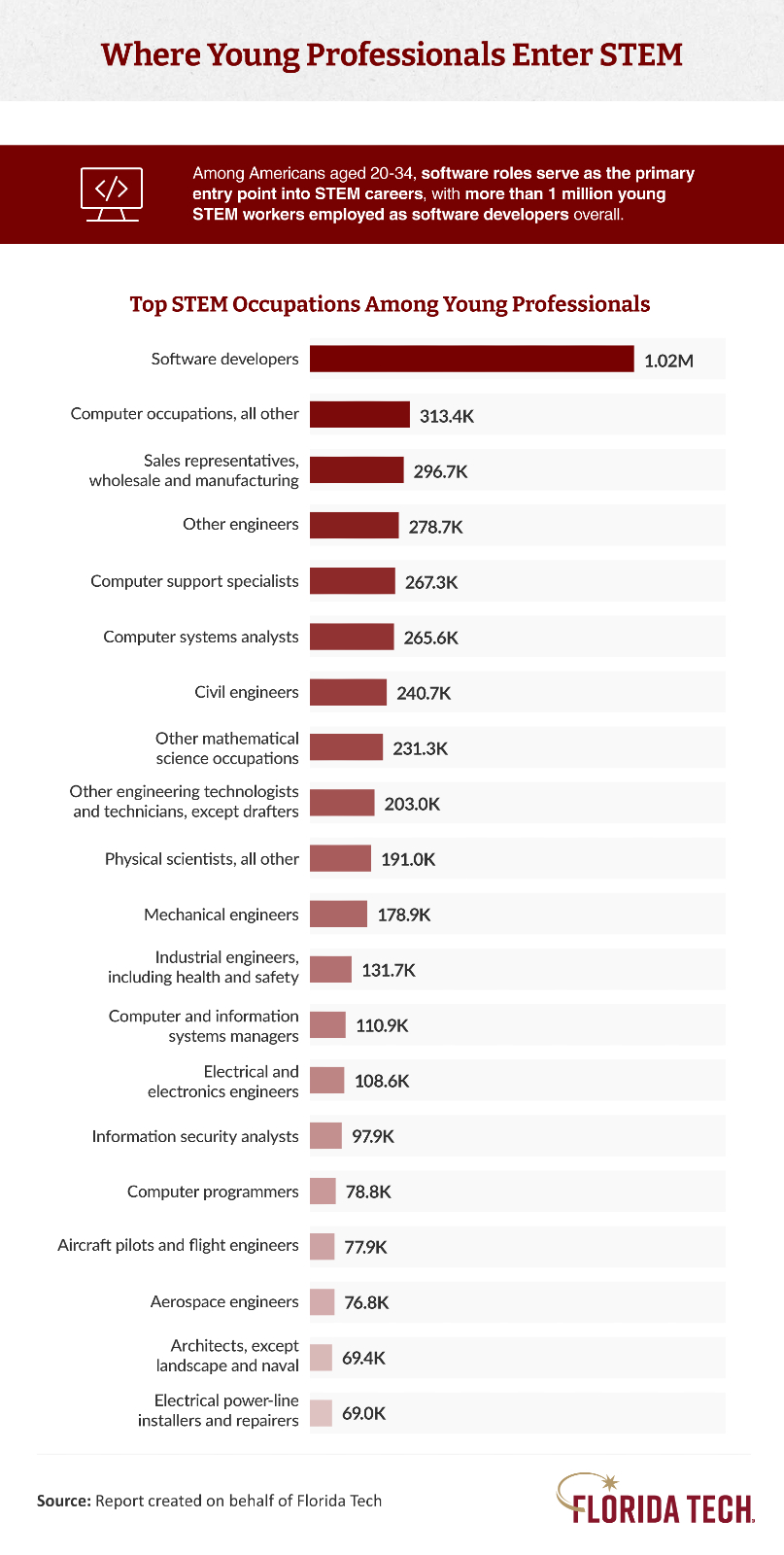
Software and computing roles dominated early STEM employment, reflecting the widespread adoption of information technology, data analysis and software engineering across industries.
Top 10 STEM Occupations Among Young Professionals (Ages 20-34)
- Software developers: 1.02M
- Computer occupations, all other: 313.4K
- Sales representatives, wholesale and manufacturing: 296.7K
- Other engineers: 278.7K
- Computer support specialists: 267.3K
- Computer systems analysts: 265.6K
- Civil engineers: 240.7K
- Other mathematical science occupations: 231.3K
- Other engineering technologists and technicians, except drafters: 203.0K
- Physical scientists, all other: 191.0K
These roles often require a bachelor’s degree in computer science, engineering or a related field and serve as common entry points into software engineering, data science, cybersecurity and information systems careers.
Understanding which STEM roles employ relatively few young adults is just as important as identifying the most common entry points. Lower employment numbers can reflect narrower career pipelines, higher education requirements, geographic constraints or slower hiring cycles, all of which may affect job availability after graduation.
Bottom 10 STEM Occupations Among Young Professionals (Ages 20-34)
- Atmospheric and space scientists: 6.2K
- Astronomers and physicists: 6.6K
- Petroleum, mining and geological engineers (including mining safety): 7.2K
- Forest and conservation workers: 7.9K
- Environmental science and geoscience technicians, and nuclear technicians: 8.4K
- Marine engineers and naval architects: 8.8K
- Nuclear medicine technologists and medical dosimetrists: 9.5K
- Surveyors, cartographers and photogrammetrists: 10.2K
- Landscape architects: 11.0K
- Agricultural and food scientists: 11.4K
For students and early professionals, this context can help set realistic expectations, guide specialization choices and clarify whether a field offers broad early-career opportunities or a more specialized path that may require additional planning.
U.S. Metro Areas With the Largest Young STEM Workforces
Location plays a major role in shaping career opportunities, particularly for STEM professionals seeking access to large employers, research institutions and diverse job markets. Big city environments like New York City attract workers by offering more job opportunities and strong professional networks, though these advantages often come with higher housing costs and costs of living.
The following rankings highlight U.S. metro areas with the largest estimated populations of STEM workers ages 20-34, showing where young professionals are most concentrated by sheer workforce size.
Top 10 U.S. Metro Areas by Estimated Number of Young STEM Workers (Ages 20-34)
- New York-Newark-Jersey City, New York and New Jersey: 347.1K
- Los Angeles-Long Beach-Anaheim, California: 189.6K
- Seattle-Tacoma-Bellevue, Washington: 171.7K
- Dallas-Fort Worth-Arlington, Texas: 171.6K
- Chicago-Naperville-Elgin, Illinois and Indiana: 168.9K
- Washington-Arlington-Alexandria, District of Columbia, Virginia, Maryland and West Virginia: 166.6K
- San Francisco-Oakland-Fremont, California: 154.1K
- Boston-Cambridge-Newton, Massachusetts and New Hampshire: 141.0K
- San Jose-Sunnyvale-Santa Clara, California: 125.6K
- Philadelphia-Camden-Wilmington, Pennsylvania, New Jersey, Delaware and Maryland: 115.3K
These major cities across the East Coast, Midwest and Bay Area often rank among the best cities for young professionals due to the concentration of employers, health care systems, universities and cultural amenities, such as nightlife. Beyond the top 10, several fast-growing and mid-sized metro areas also support sizable young STEM workforces.
Additional U.S. metros ranking in the top 25 include:
- Atlanta-Sandy Springs-Roswell, Georgia: 110.7K
- Houston-Pasadena-The Woodlands, Texas: 106.3K
- Denver-Aurora-Centennial, Colorado: 92.3K
- San Diego-Chula Vista-Carlsbad, California: 84.7K
- Detroit-Warren-Dearborn, Michigan: 84.2K
- Phoenix-Mesa-Chandler, Arizona: 82.5K
- Austin-Round Rock-San Marcos, Texas: 80.1K
- Minneapolis-St. Paul-Bloomington, MN-WI: 79.3K
- Miami-Fort Lauderdale-West Palm Beach, Florida: 63.2K
- Baltimore-Columbia-Towson, Maryland: 60.4K
- Charlotte-Concord-Gastonia, North Carolina and South Carolina: 51.8K
- Tampa-St. Petersburg-Clearwater, Florida: 48.6K
- St. Louis, Missouri and Illinois: 46.8K
- Portland-Vancouver-Hillsboro, Oregon and Washington: 46.4K
- Pittsburgh, Pennsylvania: 46.3K
At the opposite end of the spectrum, smaller and more rural metro areas tend to support far fewer young STEM workers, often due to limited employer presence, narrower industry focus or fewer early-career opportunities.
Bottom 10 U.S. Metro Areas by Estimated Number of Young STEM Workers (Ages 20-34)
- Beckley, West Virginia: 0.4K
- Goldsboro, North Carolina: 0.5K
- Lake Havasu City-Kingman, Arizona: 0.5K
- Homosassa Springs, Florida: 0.6K
- Rocky Mount, North Carolina: 0.6K
- Pueblo, Colorado: 0.7K
- Michigan City-La Porte, Indiana: 0.8K
- Muncie, Indiana: 0.8K
- Redding, California: 0.8K
- Wichita Falls, Texas: 0.8K
Where STEM Careers Are Most Concentrated Among Young Adults
Concentration indicates the extent to which STEM careers are integrated within a local economy. Cities with a high share of young adults working in STEM fields may offer stronger professional networks and clearer career pathways.
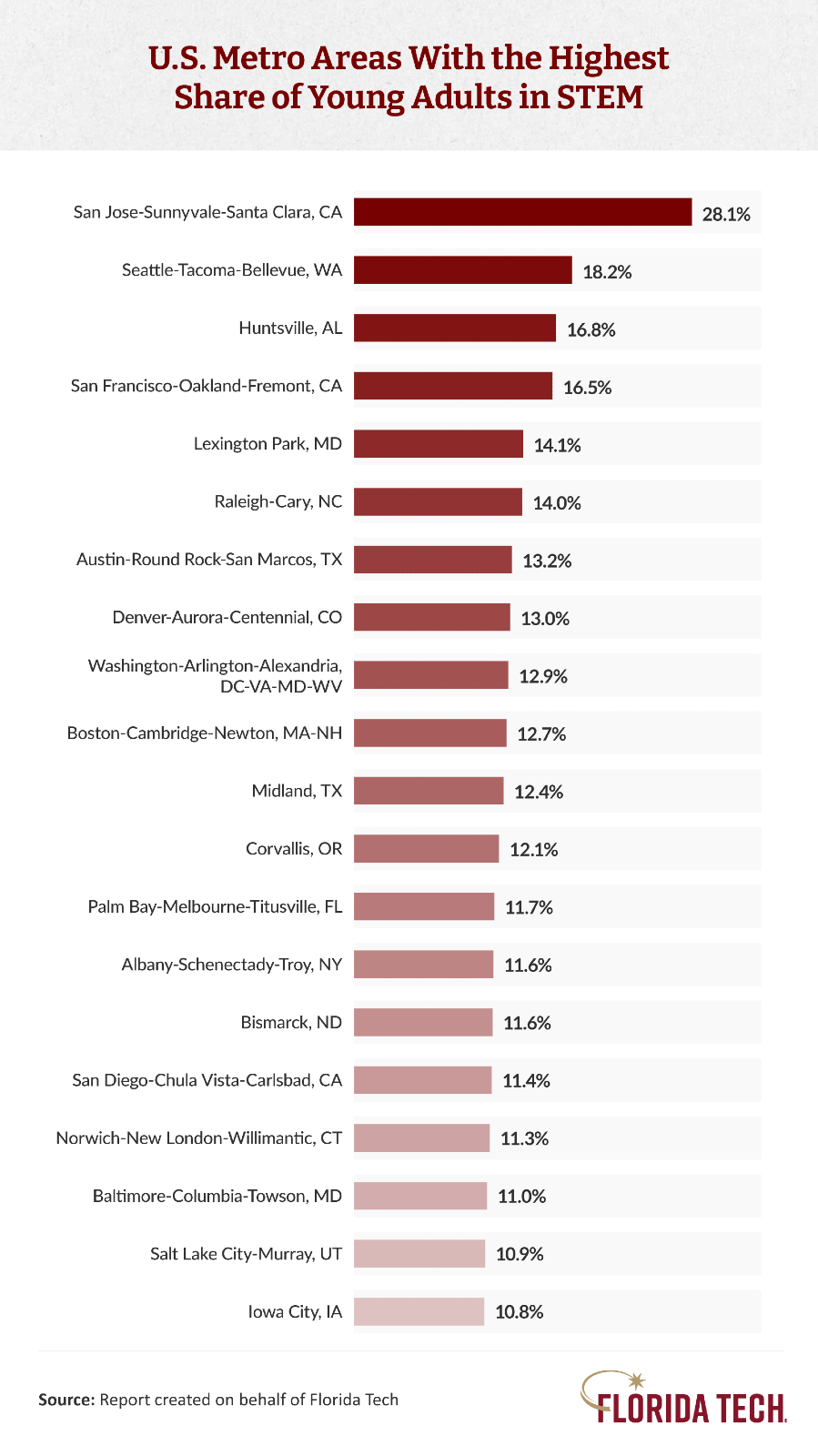
A high concentration can signal strong demand for STEM talent, particularly in software engineering, robotics, biotechnology and aerospace engineering.
U.S. Metro Areas With the Highest Concentration of STEM Workers Under 35
- San Jose-Sunnyvale-Santa Clara, California: 28.1%
- Seattle-Tacoma-Bellevue, Washington: 18.2%
- Huntsville, Alabama: 16.8%
- San Francisco-Oakland-Fremont, California: 16.5%
- Lexington Park, Maryland: 14.1%
- Raleigh-Cary, North Carolina: 14.0%
- Austin-Round Rock-San Marcos, Texas: 13.2%
- Denver-Aurora-Centennial, Colorado: 13.0%
- Washington-Arlington-Alexandria, District of Columbia, Virginia, Maryland and West Virginia: 12.9%
- Boston-Cambridge-Newton, Massachusetts and New Hampshire: 12.7%
Top STEM Career Options for Students and Early Professionals
For students choosing a STEM major or professionals considering a master’s degree, understanding which roles align with strong job growth and competitive wages can help clarify long-term career goals. According to BLS, STEM employment is projected to grow 8.1% from 2024 to 2034, far outpacing projected growth for non-STEM occupations (2.7%). Many STEM roles also offer significantly higher earnings, with a median annual wage of $103,580 in 2024, more than double the median for non-STEM jobs ($48,000).
Within STEM, computer and information technology occupations stand out as some of the fastest-growing and highest-paying options. The BLS projects much faster-than-average growth for these roles through 2034, with about 317,700 job openings each year driven by both new demand and worker replacement. Median pay in this category reached $105,990 in 2024, well above the national median across all occupations ($49,500).
Other popular and in-demand STEM career options include:
- Software engineers and web developers, supported by continued growth in software engineering, cloud computing and enterprise applications
- Data scientists, statisticians and operations research analysts, reflecting rising demand for data analysis, modeling and decision support across industries
- Information security analysts and computer network architects, driven by cybersecurity needs and expanding digital infrastructure
- Mechanical engineers, electrical engineers and industrial engineers supporting manufacturing, automation and advanced production systems
- Aerospace engineers, chemical engineers and biomedical engineers working at the intersection of engineering, health care and biotechnology
- Biochemists and environmental engineers contributing to research, sustainability initiatives and public health efforts
Many of these careers require a bachelor’s degree for entry, while advancement into leadership, research or specialized technical roles often benefits from a master’s degree in a related field. Together, strong projected growth and above-average wages make these STEM pathways especially attractive for students and early-career professionals planning for long-term opportunities.
How to Choose the Best Place to Work in STEM
Choosing where to live and work is as important as choosing a career path. While some locations offer abundant job opportunities, students and professionals should evaluate multiple factors before committing to a region. Key considerations include:
- Job market strength: Focus on regions with high STEM employment or strong concentration in your specific field, which can signal better job availability and long-term stability.
- Cost of living: High-paying roles in major cities or tech hubs may come with higher housing and transportation costs, which can affect overall financial outcomes.
- Career opportunities: Cities with a mix of large employers, startups and research institutions often provide greater mobility and advancement over time.
- Quality of life: Access to health care, public transportation, cultural amenities and outdoor space can influence day-to-day satisfaction and long-term sustainability.
- Real-world experience: Regions with internships, research labs, defense contractors or applied industry projects can help early-career professionals build practical experience faster.
Balancing professional opportunity with lifestyle considerations can help STEM professionals choose locations that support both career growth and personal well-being.
Making Informed Career Decisions in STEM: Aligning Skills, Location and Opportunity
For current and prospective students, building a successful STEM career requires more than technical skills alone. This analysis shows that software and computing roles remain the most common entry points into STEM, while large and innovation-driven U.S. cities attract the greatest numbers of young STEM workers.
It also highlights regions where STEM careers are deeply embedded in the local economy, offering strong peer networks and long-term career opportunities. By aligning education, location and career goals, students and early professionals can navigate a rapidly evolving job market with greater knowledge and confidence.
Methodology
This analysis uses public microdata from the U.S. Census Bureau’s American Community Survey (ACS), accessed via IPUMS USA, to explore where young adults build STEM careers in major U.S. metropolitan areas. The study examines adults ages 20-34 working in STEM occupations, defined using the BLS OES STEM occupation list and applied to IPUMS ACS microdata.
Using the most recent one-year ACS microdata, employed individuals ages 20-34 were identified and grouped by metropolitan area (using IPUMS metro identifiers) to highlight metros with the largest counts and concentrations of young STEM workers, as well as large metros where young STEM workers are relatively scarce. Counts are weighted using ACS person weights (PERWT).
This is a nonexperimental, exploratory analysis of survey microdata and is not intended to represent every U.S. metropolitan area or to provide official labor force statistics. Metropolitan areas that cannot be uniquely identified in the public ACS microdata are excluded from the study.
About Florida Tech
Florida Institute of Technology offers an online Master of Business Administration (MBA) in Information Technology Management program designed for working professionals seeking leadership roles in technology-driven organizations. The program combines core business fundamentals with advanced study in information systems, technology strategy and management to help students strengthen both technical and executive decision-making skills. Graduates are prepared for roles such as IT manager, technology consultant, information systems director and other leadership positions that require both business insight and technical expertise.
Fair Use Statement
The information presented in this article may be used for noncommercial purposes only. If shared or referenced, proper attribution with a link back to Florida Tech must be provided.

