
Understanding why people commit crimes and how to stop them is at the core of criminal profiling. Criminal profilers work closely with law enforcement agencies to analyze crime scenes, evaluate criminal behavior and help identify potential suspects. For those intrigued by the intersection of human psychology, criminal justice and forensic science, learning how to become a criminal profiler may be the first step toward a rewarding and challenging career. If you’re ready to take the first step toward this career path, consider enrolling in the online Bachelor of Arts (B.A.) in Applied Psychology – Forensic Psychology program from Florida Institute of Technology to build the specialized knowledge and skills criminal profilers rely on.
This guide explores the key steps to becoming a criminal profiler, including the education required, the skills that matter most, and what to expect in terms of job opportunities and salary. Whether you’re just starting or looking to advance your law enforcement career, understanding the full education and career path to this role will help you make informed decisions along the way.
What Does a Criminal Profiler Do?
Criminal profilers use a mix of behavioral science and investigative techniques to help solve complex and often violent crimes. By studying crime scenes, offender patterns and victimology, they develop detailed profiles of potential suspects, including likely traits, motivations and behaviors. These profiles help law enforcement and government agencies narrow down leads, predict future behavior and better understand the criminal mind.
Many criminal profilers work within specialized units, such as the Behavioral Analysis Unit (BAU) at the Federal Bureau of Investigation (FBI), where they apply criminal investigative analysis to high-profile cases involving serial crimes, abductions and threats to public safety. Others work with state or local police departments, offering their expertise to support homicide investigations, sexual assault cases and other violent crimes.
While the role may vary by agency or jurisdiction, the core objective remains the same: provide actionable psychological insights that assist investigators in identifying and apprehending offenders. This career requires a deep understanding of both criminal behavior and human psychology, making it ideal for those drawn to fields like forensic psychology or criminology.
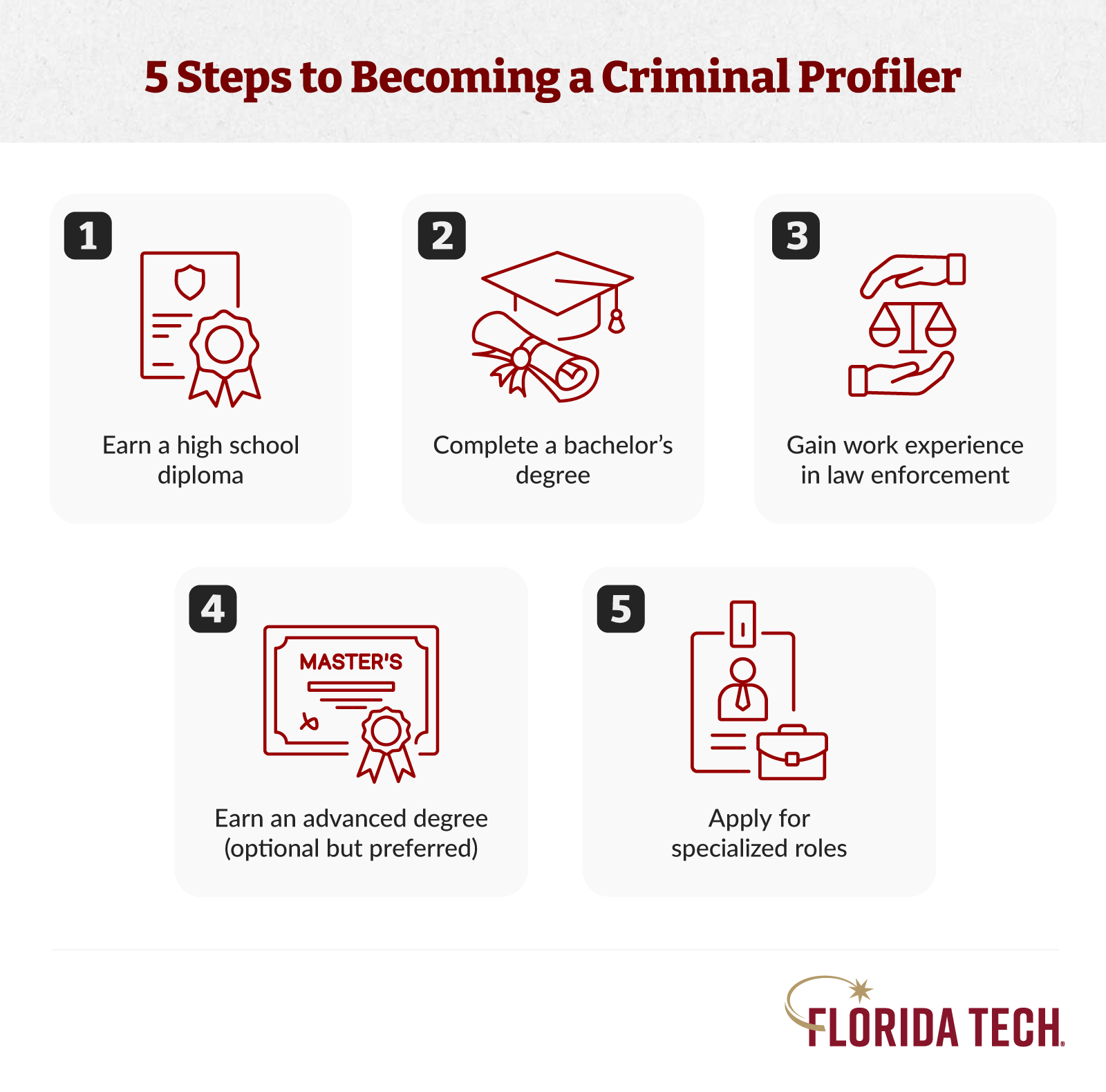
Step-by-Step: How to Become a Criminal Profiler
The path to becoming a criminal profiler combines education, practical law enforcement experience and psychological training. Below is a step-by-step guide to pursuing this specialized career.
- Earn a High School Diploma
A strong academic foundation starts in high school. Aspiring criminal profilers should focus on subjects like psychology, sociology, English and science, all of which help build critical thinking, communication skills and an understanding of human behavior. Volunteering or participating in criminal justice clubs can also provide early exposure to the field.
- Complete a Bachelor’s Degree
Most criminal profilers begin with a bachelor’s degree in a related field. Common majors include psychology, criminal justice, criminology or forensic psychology. These programs introduce core concepts, including abnormal psychology, crime scene analysis and criminal behavior. A strong option is Florida Tech’s online applied psychology B.A. degree with an emphasis in forensic psychology, which blends psychological theory with practical applications in criminal justice.
- Gain Work Experience in Law Enforcement
Before moving into psychological profiling, professionals typically gain field experience in law enforcement roles such as police officers, crime analysts or detectives. Attending a law enforcement or police academy and working on criminal investigations help develop the observational, procedural and interpersonal skills needed in profiling. Agencies often look for candidates with years of experience working in violent crime or investigative units.
- Earn an Advanced Degree (Optional but Preferred)
While not always required, earning a master’s degree or doctorate degree in forensic psychology, criminology or a related field can significantly improve your chances of working in elite roles, such as with the FBI’s BAU. Advanced degrees also open the door to becoming expert witnesses, academic researchers or instructors in criminal justice programs.
- Apply for Specialized Roles
With the right mix of education and experience, the final step is applying for specialized positions. This could include working with federal law enforcement agencies such as the FBI, Department of Homeland Security or U.S. Marshals Service, or within state-level behavioral analysis units. These roles require not only investigative skills but also in-depth knowledge of criminal psychology, behavioral science and the criminal justice system.
What Are the Essential Skills and Traits of a Criminal Profiler?
Successful criminal profilers combine psychological expertise with investigative intuition. Below are the key skills and traits that set top profilers apart:
- Critical thinking: Ability to assess complex crime scenes and develop logical, evidence-based conclusions
- Analytical skills: Identifying patterns, connecting behavioral clues and interpreting forensic evidence
- Abnormal psychology: Deep understanding of mental disorders and how they relate to criminal behavior
- Understanding human behavior: Knowledge of motives, personality types and behavioral cues in high-stakes situations
- Attention to detail: Carefully observing small details that may lead to larger insights about a suspect’s profile
- People skills: Strong interpersonal communication, especially when collaborating with law enforcement teams or interviewing witnesses
These traits are essential in turning data and observation into actionable profiles that help solve crimes and support the justice system.
What Are Emerging Trends in Criminal Profiling Careers?
As criminal profiling continues to evolve, professionals in this field must adapt to new tools, technologies and methodologies. These trends reflect the direction of modern investigative work and the growing need for profilers with multidisciplinary training.
- Digital forensics and cybercrime: Profilers now collaborate with cyber investigators to track behavior in online crimes, analyze digital evidence and investigate dark web activity.
- AI and predictive modeling: Law enforcement increasingly uses data science, artificial intelligence and algorithms to support behavioral analysis.
- Mental health integration: Trauma-informed approaches and psychological assessments play a larger role in investigations.
- Expanded training opportunities: Agencies beyond the FBI, including state and local departments, are creating formal pathways into behavioral analysis careers.
Staying ahead in this career means understanding not just human behavior, but also the systems and technologies that influence how we detect and prevent crime. Programs like Florida Tech’s online forensic psychology degree prepare students for this new era of criminal profiling.
Criminal Profiler Salary and Job Outlook
Although the U.S. Bureau of Labor Statistics (BLS) does not separately track “criminal profiler” as a distinct job title, it includes this role within the broader category of detectives and criminal investigators. These professionals often work in local police departments, federal agencies and specialized investigative units such as the BAU.
Here’s a breakdown of the most recent salary and employment data available:
|
Criminal Profiler Salary and Employment Data |
|
| Category | Details |
| Median annual salary (2024) | $77,270 |
| Top 10% salary range | $128,210+ |
| Highest-paying industries | Federal government and specialized agencies |
| Job growth outlook (2024–2034) | 3% (slower than average) |
| Number employed | 117,900 detectives and criminal investigators in the U.S. |
| Note | “Criminal profiler” is a specialization within this category and not individually tracked by BLS. |
Earnings can vary widely by location, experience and agency level. Whether working at the federal level or within a local law enforcement agency, profilers with advanced levels of education and extensive experience often earn salaries at the higher end of this spectrum.
Launch Your Criminal Profiling Career With the Right Education
Becoming a criminal profiler requires a unique blend of education, field experience and psychological insight. From earning your high school diploma to gaining hands-on law enforcement experience and pursuing advanced degrees in forensic psychology or criminology, each step builds the skills needed to succeed in this challenging and rewarding field.
Along the way, developing traits like critical thinking, attention to detail and a deep understanding of human behavior is essential for crafting accurate profiles and supporting law enforcement investigations. While many profilers work in traditional police settings, others support high-level operations within federal agencies, such as the BAU.
For aspiring profilers, a strong educational foundation starts with the right degree. Florida Tech’s online Bachelor of Arts in Applied Psychology – Forensic Psychology program offers the psychological theory, analytical training and real-world applications that can help launch your career. The university’s flexible, fully online format allows you to build your credentials while balancing other commitments, preparing you to take the next step toward a future in criminal profiling.
FAQ: Becoming a Criminal Profiler
Choosing a career in criminal profiling raises many questions, especially about education, experience and job outlook. Below are answers to some of the most frequently asked questions, written with voice search and quick skimming in mind.
Do criminal profilers need law enforcement experience?
Yes. While not always required, most criminal profilers have prior experience in law enforcement, typically as detectives, police officers or crime analysts. This background provides essential skills in crime scene investigation and working with law enforcement agencies.
Is criminal profiling a fast-growing field?
Criminal profiling is a highly specialized field and not tracked separately by the BLS. It falls under broader roles like detectives and criminal investigators, which have a 3% job growth outlook through 2034, slower than average but steady in the government and public safety sectors.
What degree do you need to become a criminal profiler?
At minimum, requirements include a bachelor’s degree in psychology, criminal justice or forensic psychology. Many profilers also pursue a master’s degree or doctorate to qualify for specialized roles in behavioral analysis units or federal agencies.
Can you become a criminal profiler with a psychology degree?
Absolutely. A psychology degree, especially with a forensic psychology concentration, is a strong foundation. It equips you with the tools to understand human behavior, criminal motivation and abnormal psychology, all of which are critical for profiling work.
How long does it take to become a criminal profiler?
The full journey can take eight to 10 years, including earning a degree, attending a law enforcement academy, gaining field experience and, potentially, completing a graduate degree. Timelines vary based on educational path and agency requirements.
Do criminal profilers work for the FBI?
Some do. The FBI profilers typically work in the Behavioral Analysis Unit (BAU), which employs profilers with years of law enforcement experience and advanced education in criminal psychology or behavioral science. Entry is highly competitive.
What skills are essential for a criminal profiler?
Top skills include critical thinking, analytical reasoning, attention to detail, emotional intelligence and strong communication skills. A solid understanding of criminal behavior and forensic science is also essential.

