

Artificial intelligence (AI) is no longer just a workplace tool for Gen Z; it has now become a new source of income. A questionnaire was administered to 831 full-time employed U.S. workers ages 22 to 28 on behalf of Florida Institute of Technology (Florida Tech) to understand how this generation is using AI to earn money outside their primary jobs, which tools they rely on and how they think about education and career growth in an AI-driven economy. The findings reveal a generation that is entrepreneurial, tech-forward and still firmly committed to the value of a college degree.
Key Takeaways
- Nearly two in five Gen Z workers (39%) use AI to generate income outside their primary job.
- More than one in two Gen Z AI side hustlers (52%) say they’d quit their day job if the income became sustainable.
- More than one in five (21%) disagree that AI skills are becoming more important than a college degree for career success, and 60% say a college degree is one of the most important factors for getting a job today.
- More than half (54%) of Gen Z say AI makes them better at their jobs.
Gen Z’s AI-Powered Paychecks
Gen Z workers are increasingly turning to AI tools to build income streams beyond their nine-to-five roles. The data reveals which tools they use, how much they earn and how committed they are to this new way of working.
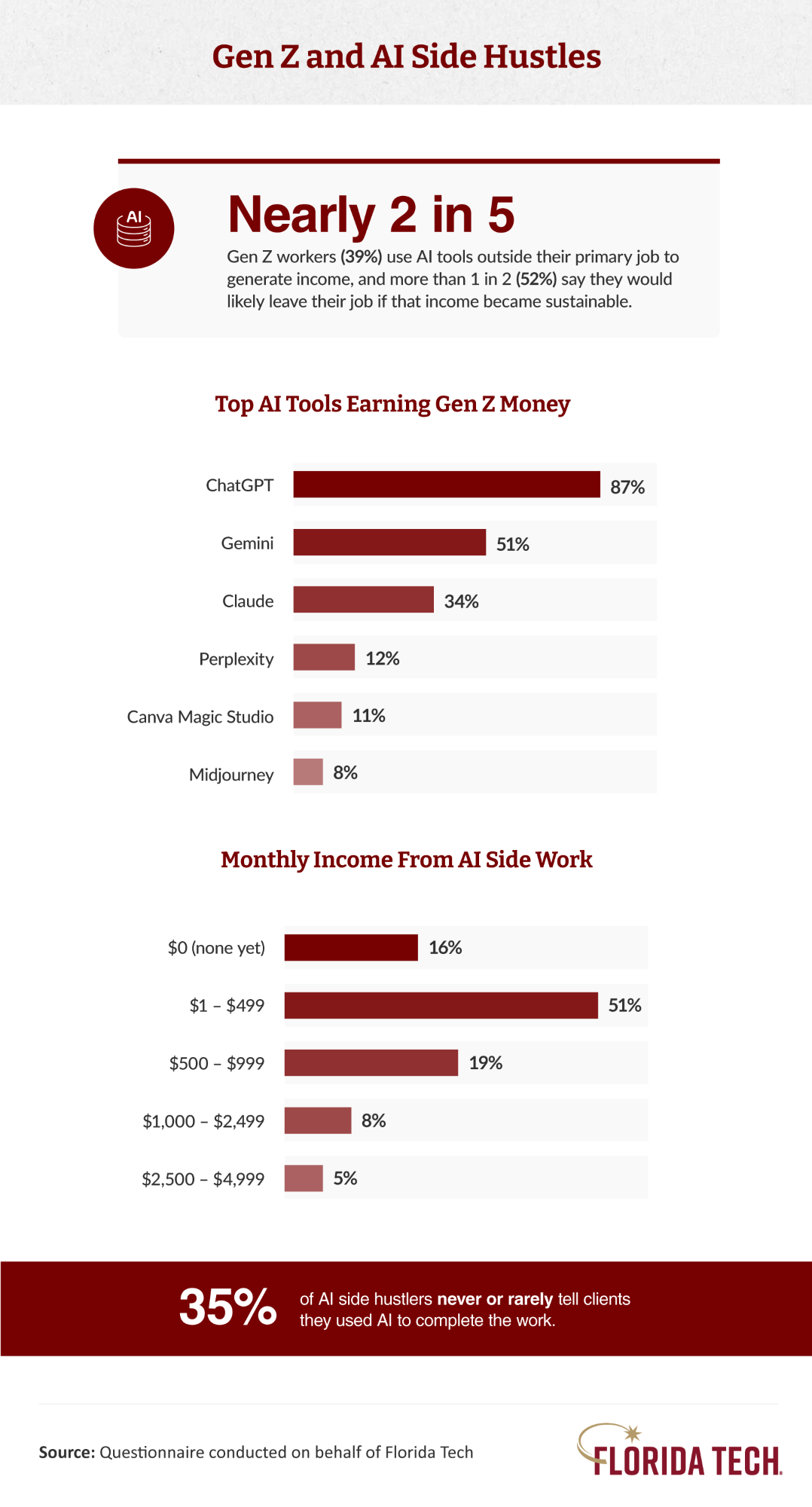
Thirty-nine percent of Gen Z full-time workers reported using AI tools to generate income outside their primary job at least sometimes. ChatGPT was the top income-earning tool among active AI side hustlers at 87%, followed by:
- Gemini (51%)
- Claude (34%)
- Perplexity (12%)
- Canva Magic Studio (11%)
When it came to earnings, 51% of active AI side hustlers earned $1 to $499 per month from AI-assisted work, while 19% earned $500 to $999. Notably, 45% of Claude users earned $500 or more per month, compared to 30% of ChatGPT users.
Most active AI side hustlers kept their time investment modest, with 53% spending one to five hours per week on AI-powered side work. Among those earning AI-assisted income, 52% said it was at least moderately likely they would leave their full-time job if their AI income became significant, including 23% who said it was very or extremely likely.
As for motivations, 40% viewed their AI side hustle as a short-term income boost, and 35% saw it as a way to experiment and learn new skills. Another 12% described it as a backup plan if their primary job became unstable, and 11% were actively building it as a long-term career path.
Gen Z, College Degrees and Career Confidence in the Age of AI
Even as AI reshapes the professional landscape, Gen Z workers have not written off the importance of formal education. Their views on degrees, workplace freedom and career advancement reveal a generation navigating both tradition and technological change.
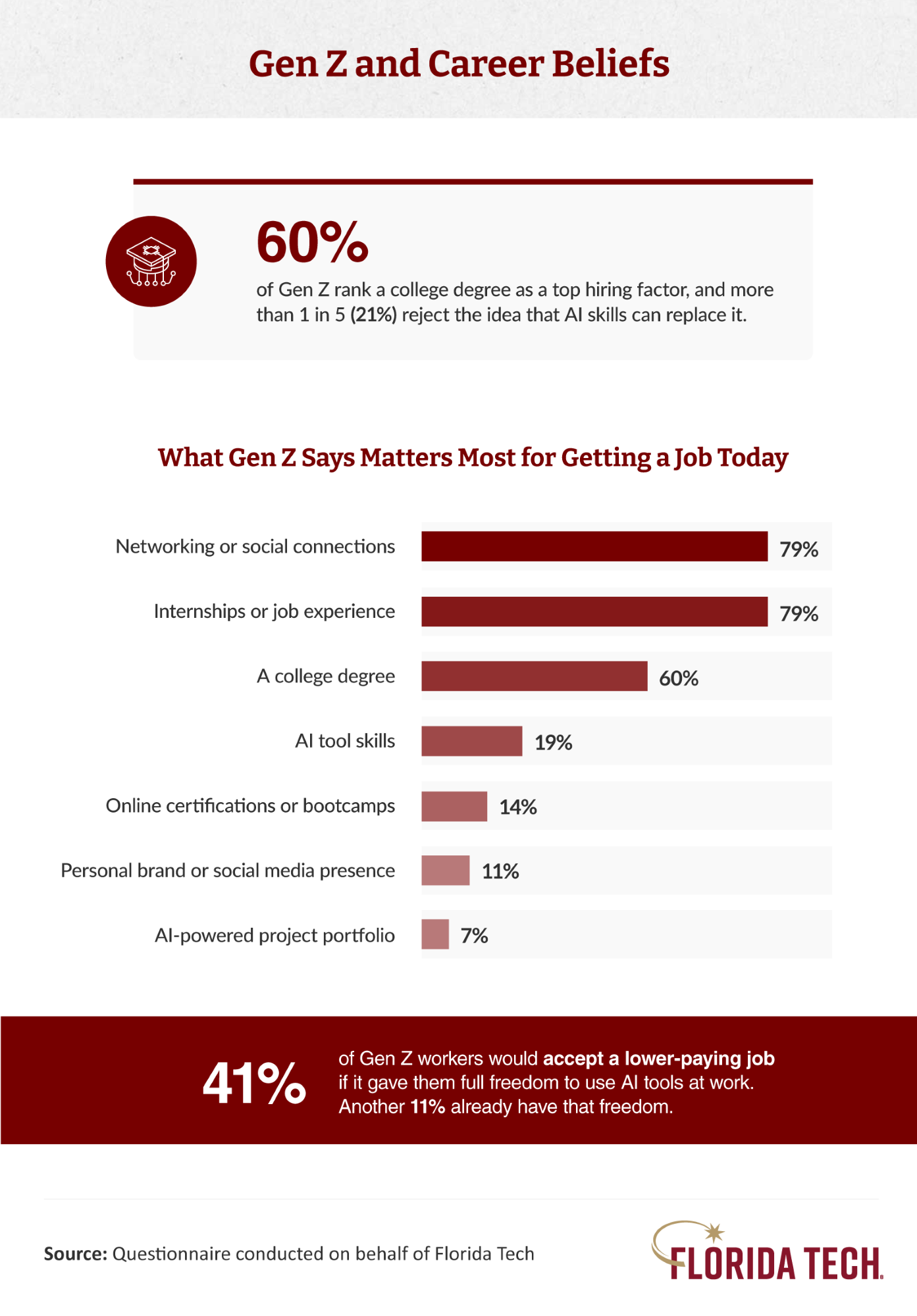
More than one in five Gen Z workers (21%) disagreed that AI skills are becoming more important than a college degree for career success. In fact, 60% said a college degree remains one of the most important factors for getting a job today, placing it third behind networking or social connections (79%) and internships or job experience (79%). AI tool skills ranked fourth at 19%.
Despite valuing degrees, Gen Z workers also recognized AI’s professional impact. More than half (54%) agreed or strongly agreed that AI tools helped them perform better at work. Meanwhile, 19% reported being passed over at least once for a role they felt their AI skills qualified them for.
Workplace flexibility around AI also mattered to this group. Forty-one percent said they would accept a lower-paying job if it gave them full freedom to use AI tools at work, and 56% said they would be comfortable working for a manager who openly used AI tools.
Where AI Ambition and Academic Value Meet
Gen Z is approaching AI with both ambition and pragmatism, using it to earn income, improve job performance and explore new career possibilities, all while maintaining a strong belief in the value of a college degree. The data from this questionnaire suggests that for this generation, AI is not a replacement for education but a complement to it.
As the workforce continues to evolve, students who combine formal credentials with practical AI skills may be best positioned to thrive. Understanding where this generation places its confidence can help educators and institutions better support the next wave of working professionals.
Methodology
This survey was conducted among 831 full-time employed U.S. workers ages 22 to 28. Data was collected in April 2026. Respondents were screened to confirm full-time employment status. Respondents who failed an embedded attention check were excluded from the final analysis.
Questions about AI-powered side-hustle behavior, including the tools used, income earned, disclosure habits, hours worked and job-leaving intent, were asked only of the respondents who reported using AI tools to generate outside income at least sometimes. All percentages are rounded to the nearest whole number.
About Florida Tech
Florida Tech is a private, not-for-profit, STEM-focused university offering 100% online degree programs designed for working professionals. Our online Master of Business Administration programs combine business leadership fundamentals with in-demand technical skills, preparing graduates for careers in a technology-driven economy. With multiple start dates, a streamlined admissions process and faculty who bring real-world experience to the classroom, Florida Tech makes it possible to advance your education without putting your career on hold.
Fair Use Statement
The data and findings presented in this article are available for noncommercial use only. If you reference or republish this content, please include a link and proper attribution to Florida Tech.

