

According to the U.S. Bureau of Labor Statistics, the demand for skilled professionals in Science, Technology, Engineering and Mathematics (STEM) fields is expected to skyrocket over the next several years. The federal government’s employment projections show an 8.1% increase in STEM jobs and median earnings of $103,580 per year. That’s much higher than the 2.7% increase the BLS expects among non-STEM occupations. For anyone considering a STEM degree, the timing has never been better.
A recent questionnaire conducted on behalf of Florida Tech surveyed 421 STEM professionals, including students, college graduates and working professionals, to better understand what draws people to STEM occupations, what challenges they face and why most say they would do it all over again. Florida Tech sponsored this research to help prospective and current students make more informed career decisions. The findings cover everything from burnout and bias to advancement and optimism, offering an overview of what STEM careers are really like and how the field is evolving.
Key Takeaways
- Over three in four STEM professionals (78%) feel pressure to develop AI skills just to stay competitive.
- Four in five STEM professionals (80%) have experienced burnout in their careers.
- Most STEM professionals (86%) have felt pressure to prove their competence at work.
- Roughly half of STEM professionals (53%) agree that companies are making meaningful efforts to recruit and retain women in STEM roles.
- Just over half of STEM professionals (59%) believe gender bias in the field has improved in recent years.
- 59% of STEM professionals say they have clear opportunities for advancement in their current role or academic path.
Where STEM Talent Wants to Go Next and the Influence of AI
STEM careers continue to attract individuals driven by curiosity, purpose and the desire to solve complex problems. For many, exposure via AI and social media played a key role in their career goals.
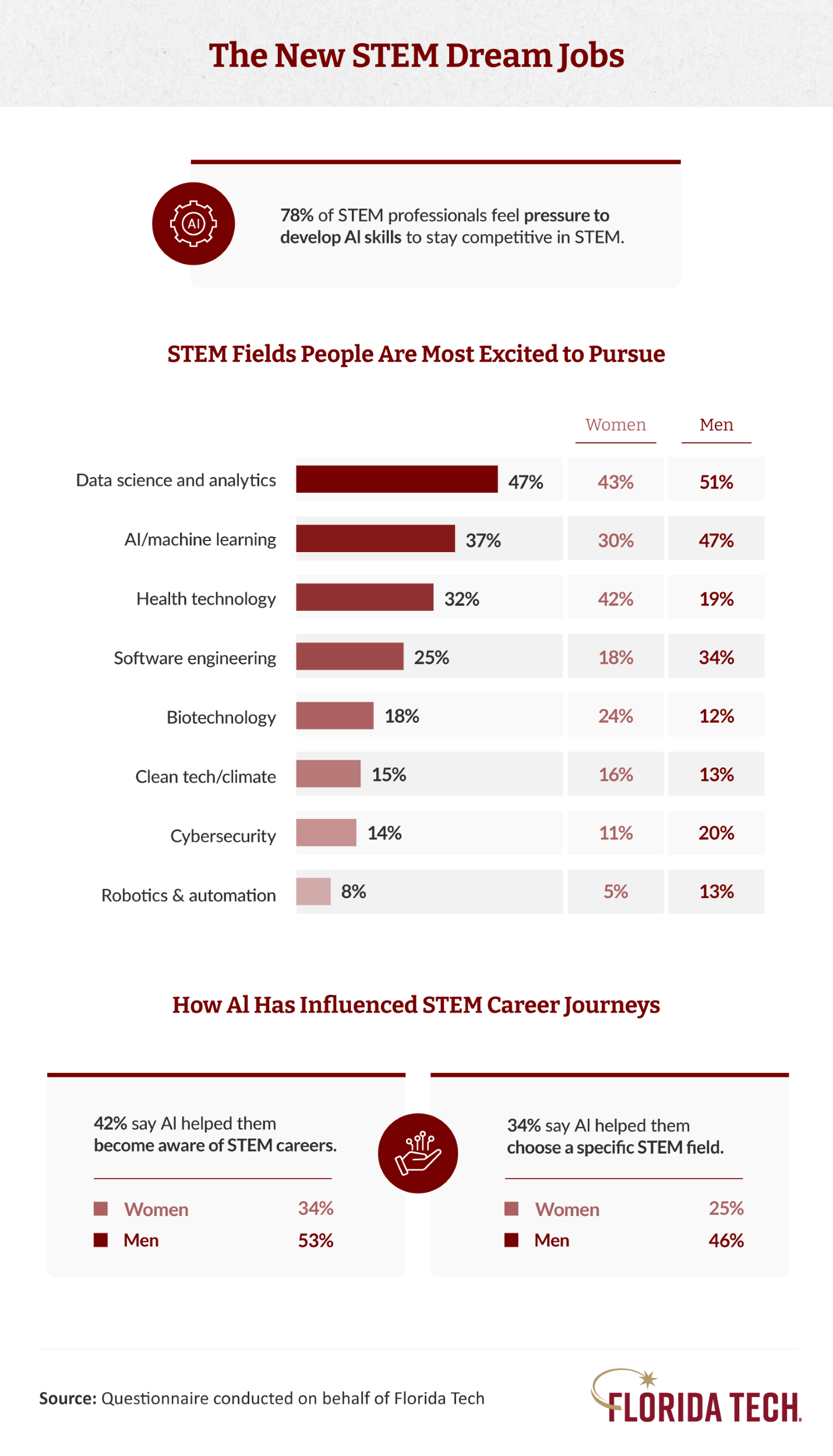
According to the National Science Board’s 2026 report, data science, information security analysis and operations research analysis are projected to be among the fastest-growing occupations between 2024 and 2034. That tracks closely with what STEM professionals themselves are excited about. Data science and analytics is the STEM field people are most interested in pursuing, as cited by 47% of respondents.
AI and machine learning was the next most popular field at 37%. As automation and advanced tools change the world, people are adapting their skill sets and leveraging AI:
- A strong majority of respondents (78%) reported feeling pressure to develop AI skills to remain competitive in STEM jobs.
- More than two in five (42%) said that AI increased their awareness of STEM careers, and 34% said it helped them choose their field of study.
- About one-third of STEM professionals (32%) used AI-based tools to secure internships or job interviews, with similar usage among men (34%) and women (30%).
Social influence also greatly affected career paths. Overall, 69% of women and 64% of men said social media made STEM careers feel more accessible to them. In addition, 67% of women reported that seeing other women succeed in STEM influenced their career choices. However, only 30% of men said the same about seeing other men succeed. This suggests that role model visibility may affect career decisions differently across genders.
What Initially Drew You to Study or Work in STEM?
Personal motivations varied across generations, with many respondents citing real-world experiences as inspiration. Spanning experiences such as health care challenges, environmental events and early fascination with technology, these stories reflect the diverse pathways that lead individuals into STEM education and careers:
“My daughter was born with a rare disorder, and I wanted to learn more about how to help her.”
— Gen X STEM professional
“When Hurricane Sandy hit my hometown, I knew I wanted to be a meteorologist.”
— Gen Z STEM professional
“Most likely it was all the TV shows I grew up watching about forensics and working in a lab.”
— Millennial STEM professional
“I was fascinated with technology right from when I was a child and wanted to know what it was all about. Making magical things happen just at the press of a button or a command.”
— Baby boomer STEM professional
“Wanting to help create a better world for those that come after me, and those that share it with me.”
— Millennial STEM professional
“I was drawn to the interconnectedness of the human body, biology and the world. I also wanted to pursue a career where I felt good about improving people’s socio-determinants of health, using science, medicine and technology.”
— Millennial STEM professional
Pressure and Persistence in STEM Occupations
While STEM careers offer opportunity and innovation, they also present challenges that affect job retention and satisfaction. Workplace culture, expectations and access to mentorship all affect experiences across the STEM workforce.
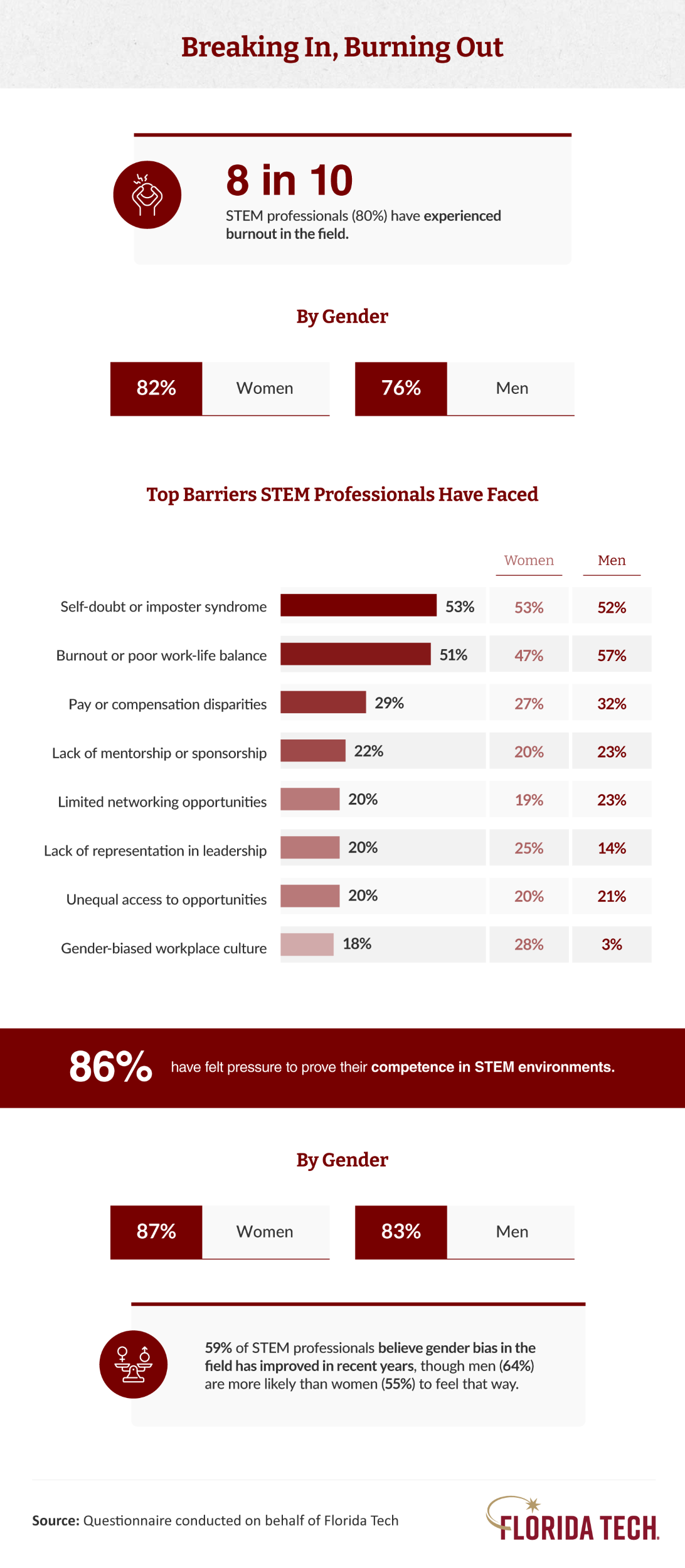
The National Academies of Sciences, Engineering and Medicine identified burnout as one of the defining challenges facing the STEM workforce, noting that its causes are complex. This aligns with what STEM professionals reported here. A significant 86% said they felt pressure to prove their competence at work, and 80% said they have experienced burnout.
Factors such as social isolation impacted 42% of burned-out women and 36% of men experiencing burnout, emphasizing the need for stronger support systems. Gender-based expectations also contributed to burnout, with more women (33%) than men (6%) citing them as a factor.
Women were also more likely to report feelings of not belonging, with 19% identifying it as the most emotionally draining aspect of their experience, nearly double the rate of men at 10%. Yet, a majority of STEM professionals (59%) believe gender bias in the field has improved in recent years, including 64% of men and 55% of women.
The National Academies report also found that the most effective way to address burnout is to fix the environment, not just the individual. That finding lines up closely with what STEM professionals say would keep them in the field long-term.
Progress, Priorities and What Comes Next for the STEM Labor Market
Retention in STEM comes down to a few core things: flexibility, clear paths forward and a workplace culture where people feel they belong. The data shows both what professionals need and where the industry is making meaningful progress.
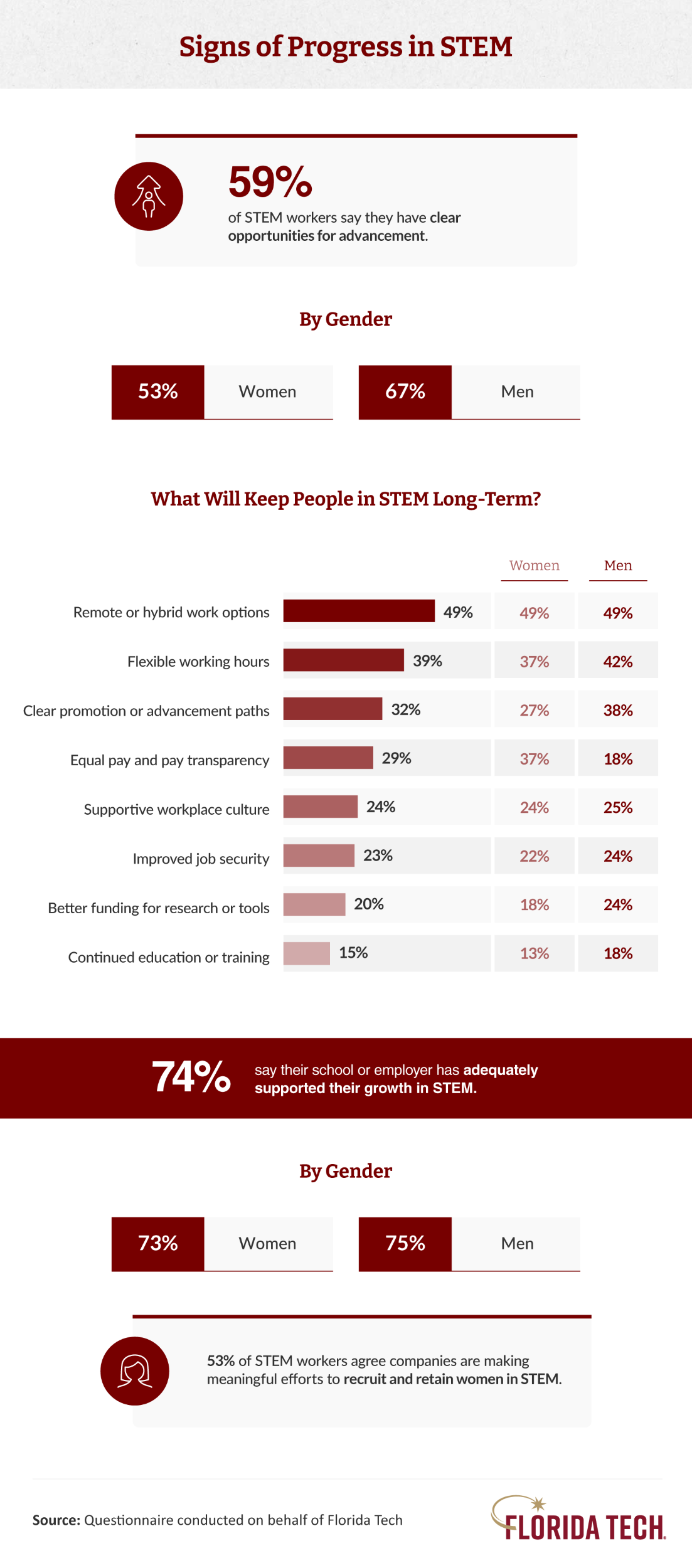
The outlook for advancement is encouraging, with 59% of STEM professionals reporting clear paths forward in their careers. Two-thirds (67%) of men expressed confidence in advancement opportunities compared to 53% of women. According to respondents, the top five factors that would help retain STEM workers included:
- Remote or hybrid work options (49%)
- Flexible working hours (39%)
- Clear promotion or advancement paths (32%)
- Equal pay and pay transparency (29%)
- Supportive workplace culture (24%)
More than half of respondents (53%) agreed that companies are making meaningful efforts to recruit and retain women in STEM roles. These initiatives include mentorship programs, leadership development opportunities and targeted outreach to underrepresented communities. Such efforts are critical in increasing the percentage of women in STEM jobs and improving overall female representation.
Looking ahead, 70% of STEM professionals believe the gender gap will close within their lifetime. Men lead the optimism at 77%, followed by women at 67%. These changes reflect the hope that changes will benefit the next generation of STEM students entering the field.
The Case for Choosing STEM
Choosing a STEM career path is not without its challenges, and the professionals who came before you will be the first to say so. However, most STEM professionals feel supported by their institutions, believe the field is improving and would choose this path again.
The demand for STEM talent is growing and so are the opportunities to work in a field you’re interested in. For anyone weighing a master’s or bachelor’s degree in STEM, the data makes a compelling case for taking the leap in higher education.
Methodology
A questionnaire of 421 STEM workers was conducted in April 2026 on behalf of Florida Institute of Technology to explore the next generation of STEM talent, the barriers holding them back and the supports that would keep them in the field long-term. Respondents included professionals currently employed in STEM-related roles (61%), recent graduates who earned a STEM degree in the past 5 years (28%), current graduate and undergraduate students in STEM (11%) and current undergraduate STEM majors (1%). Respondents were distributed across genders (56% women, 42% men, 2% non-binary or prefer not to answer) and generations (millennials 57%, Gen Z 24%, Gen X 14%, baby boomers 5%).
All percentages are rounded to the nearest whole number. Percentages are rounded independently at both the total and subgroup level. Because gender-based breakouts are reported only for women and men, with non-binary and prefer-not-to-answer respondents included in total figures but not broken out separately due to sample size, recombining the published subgroup percentages will not always reproduce the stated totals exactly.
About Florida Tech
Florida Institute of Technology offers flexible online programs and STEM courses designed for working professionals seeking to advance in STEM-related fields. Florida Tech’s online Master of Business Administration in Information Technology Management program equips students with skills in data management, global database systems and strategic decision-making. Through a curriculum that blends business fundamentals with technical expertise, students gain the knowledge needed to lead in today’s evolving STEM workforce. Graduates are prepared for leadership roles in computer science, information systems and technology-driven organizations.
Fair Use Statement
This content may be used for noncommercial purposes only. When sharing, please include proper attribution and a link back to Florida Tech.

