

A questionnaire was administered to college students, recent graduates and hiring managers on behalf of Florida Institute of Technology (Florida Tech) to better understand how artificial intelligence is reshaping resume expectations in the hiring process. The U.S. workforce is in transition, with AI literacy moving from a nice-to-have skill to a baseline expectation. For students and early-career professionals, recognizing and adapting to this shift could make the difference between standing out and getting overlooked.
The questionnaire responses were analyzed across two groups: current college students and recent graduates aged 18 to 25, and hiring managers actively involved in candidate evaluation. Their responses reveal what the modern resume looks like and how it will continue to evolve.
Key Takeaways
- 74% of early-career job seekers have used AI to help build their resume.
- 41% of early-career job seekers fear falling behind professionally if they don’t build AI skills.
- More than one in four early-career job seekers (26%) feel pressure to list AI skills on their resumes because “everyone else is doing it.”
- 53% of hiring managers say AI literacy will be a baseline job requirement within two years.
- 40% of hiring managers agree that seeing AI tools on a resume helps a candidate’s chances of being hired.
How Students Are Rethinking the Resume
AI tools have become a common part of the job search process, and students are finding new ways to use them when presenting themselves to employers. What has changed is not just how resumes are written but also what they contain.
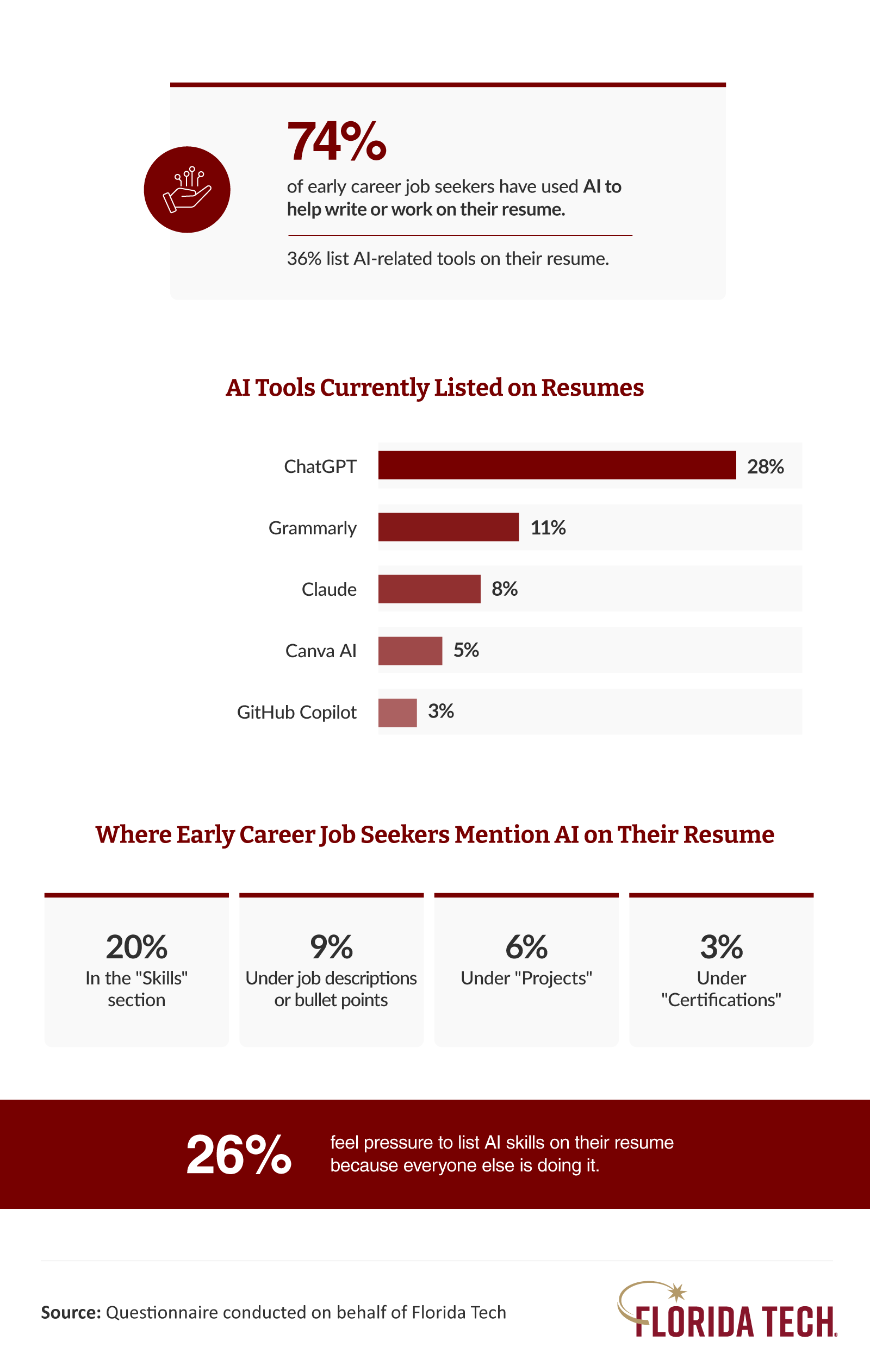
- 74% of early career job seekers report using AI in some form to help with their resumes, while 36% go a step further by listing AI tools directly on their resumes.
- Of those who listed AI tools, ChatGPT was the most commonly cited at 28%, followed by Grammarly (11%) and Claude (8%).
- 28% believe that listing AI tools could help their resume get past applicant tracking systems.
- 26% say they feel social pressure to list AI skills simply because their peers are doing it, a signal that AI fluency is becoming a perceived norm.
What Students Think Employers Want
Students are forming their own views on which skills carry the most weight in today’s job market, and AI is beginning to earn a place alongside more established technical competencies. Their perceptions reflect a generation keeping close watch on how quickly workplace expectations are evolving.
- Early career job seekers believe employers most value these skills:
- Coding languages (50%)
- Excel (47%)
- Project management (42%)
- Social media skills (31%)
- ChatGPT or AI tools (24%)
- Prompt engineering (23%)
- AI certifications (18%)
- 59% agree that AI literacy is becoming as important as traditional software skills, such as Excel, Google Suite or Adobe.
- 55% believe AI skills will become a standard expectation for most jobs within five years.
- 41% are worried about falling behind professionally if they do not develop AI skills. Men are more concerned than women (54% vs. 35%).
- 46% say they update their resume about once a year, and 35% do so quarterly.
- 54% say the pace of AI change has at least some influence on when they choose to update their resume.
What Hiring Managers Actually Look For
Employers have developed a clear-eyed view of how AI shows up in the hiring process, and they are growing more deliberate about what they consider credible. The standards they apply to AI claims on a resume are more specific than many candidates may realize.
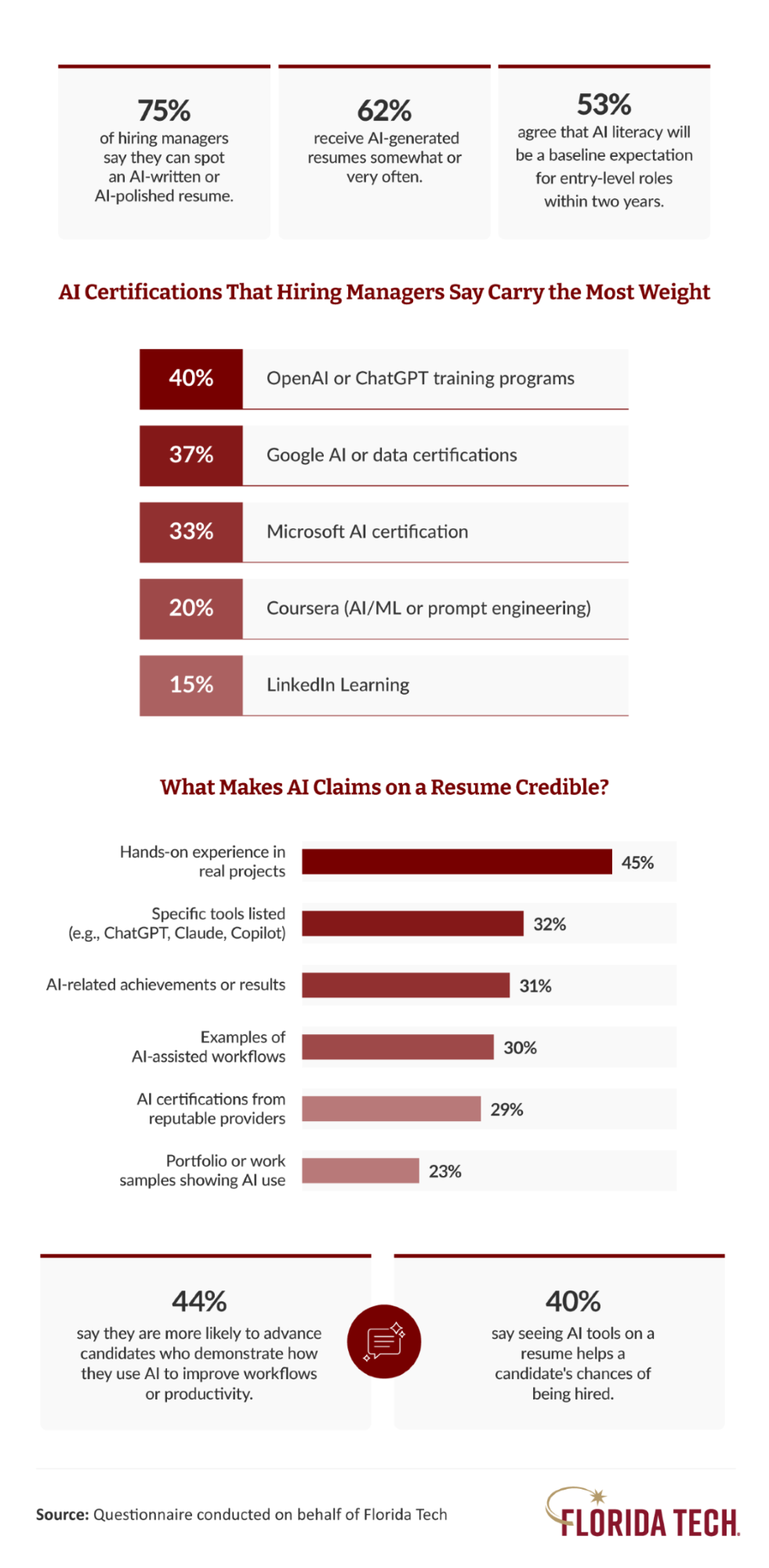
- 75% of hiring managers say they could spot an AI-written or AI-polished resume.
- 57% report seeing AI tools or skills on resumes somewhat or very often in the past year.
- 29% say they are skeptical when they see “prompt engineering” listed without supporting evidence, while 28% look for examples to verify the claim, and 23% take it as a positive signal.
- As for what makes AI credentials on a resume credible, hiring managers rank hands-on experience in real projects the highest at 45%, followed by:
- Specific tools listed (32%)
- AI-related achievements or results (31%)
- Examples of AI-assisted workflows (30%)
- 40% agree that seeing AI tools on a resume helps a candidate’s chances of being hired, and 21% say the absence of AI skills makes a candidate less competitive.
- 44% say they are more likely to advance candidates who demonstrate how they use AI to improve workflows or productivity.
- 49% agree that AI skills are becoming more important than traditional software skills, such as Excel.
- 53% agree that AI literacy will be a baseline expectation for most entry-level roles within two years.
Building the Resume That Gets You Hired
AI is no longer a specialized skill set reserved for technical roles. It is becoming a baseline expectation across industries, and both students and hiring managers are responding to this shift in real time. The most competitive candidates will be those who not only list AI tools on their resumes but also demonstrate how they applied them to produce meaningful results. For students preparing to enter the workforce, the message is clear: building and documenting AI skills now is one of the most practical investments you can make in your career.
Methodology
A questionnaire was conducted on behalf of Florida Tech to explore how college students and recent graduates are incorporating AI skills into their job search strategies, and how hiring managers are responding. Florida Tech commissioned two online questionnaires, and they were conducted in April 2026.
The first questionnaire polled 440 current college students and recent graduates aged 18 to 25 who had earned a degree within the past three years. The sample comprised 62% current students and 38% recent graduates. The gender breakdown is 58% women, 38% men and 4% other.
The second questionnaire polled 476 hiring managers and resume reviewers actively involved in candidate evaluation at their companies. The sample included decision-makers (69%) and those who assist in the review process (31%). The generation breakdown is 55% millennials, 29% Gen X, 8% Gen Z and 8% baby boomers. The gender breakdown is 52% men and 47% women.
About Florida Institute of Technology
As AI literacy becomes a baseline expectation in today’s job market, building the right technical foundation has never been more important. Florida Tech’s online Master of Science in Management with a concentration in Information Systems program prepares students to meet that demand head-on, combining rigorous, relevant coursework with the flexibility to fit your schedule. Whether you’re looking to advance in your current role or pivot into a career field where technical and analytical skills set candidates apart, this program is designed to help you get there.
Fair Use Statement
The data and findings in this article are available for noncommercial use. If you choose to share or reference this content, please include a link back to this page and proper attribution to Florida Tech.

